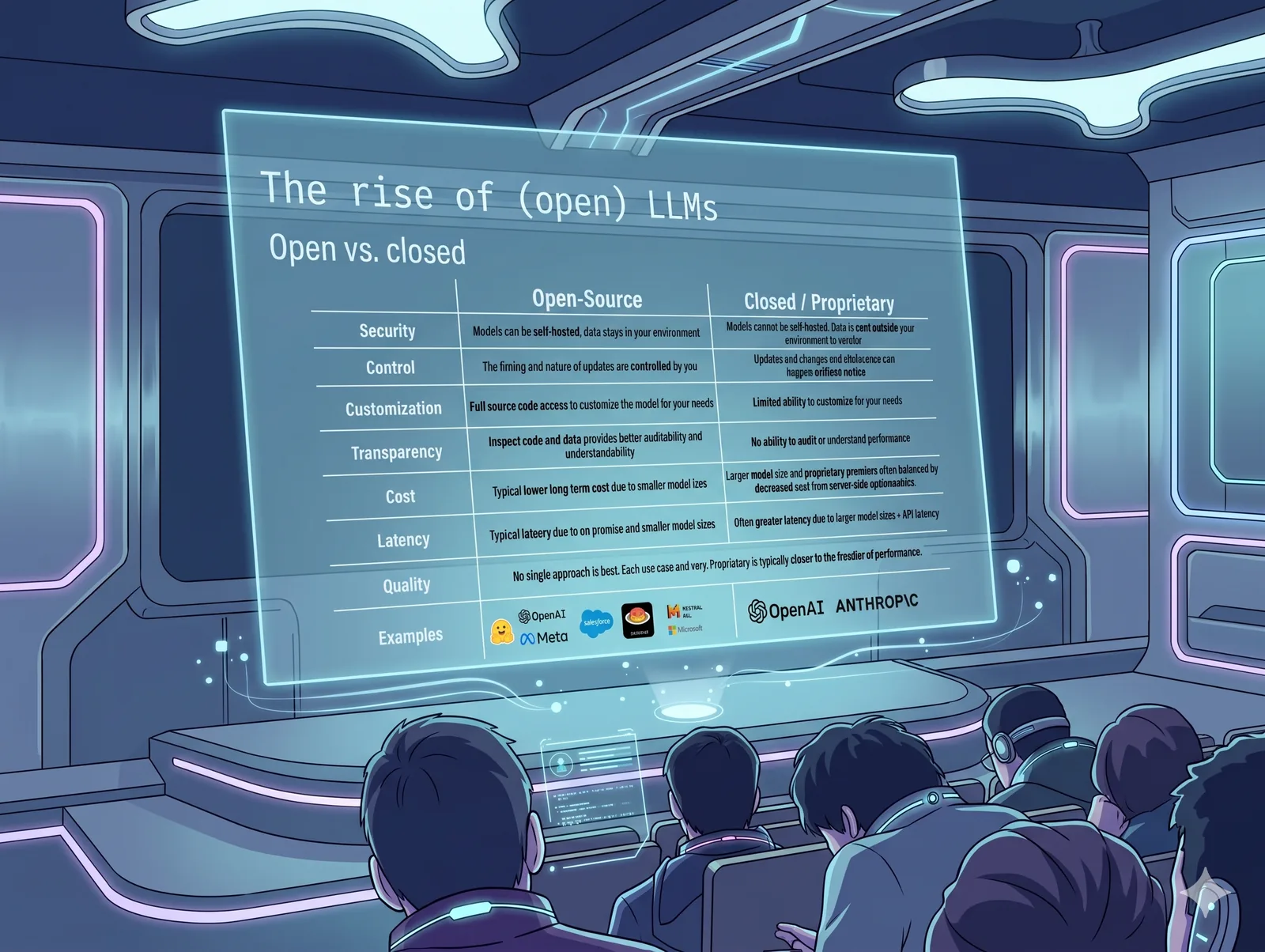
Yesterday, I attended a Tech & Meet session where the guest lecturer dove deep into Hugging Face — and I have to say, it was one of the most inspiring talks I've been to recently.
We explored how Hugging Face is shaping the AI and LLM ecosystem, making advanced models more accessible to developers and researchers around the world. A lot of what the platform offers used to live behind closed doors: state-of-the-art weights, large curated datasets, and the supporting tools that make modern ML actually usable. The talk walked through how Hugging Face has steadily become the place where all of that lives in the open, just one install away from anyone who wants to learn or build.
The community side
The open-source community aspect really stood out. Seeing how collaboration drives innovation in AI was incredibly motivating. The pattern repeats over and over: someone fine-tunes a base model, shares it, the next person picks it up, improves it, shares again. The compounding is quiet but real. It's the kind of progress that's hard to manufacture inside a closed corporate stack, because the whole point is that the next contributor can be anyone.
Transformers, model sharing, and open platforms
I left the session with a deeper appreciation for transformers, model sharing, and the power of open platforms in accelerating machine learning progress. The transformer in particular was reframed for me — not as a single architecture owned by a single lab, but as a shared piece of infrastructure the whole field has been building on for years. Hugging Face sits at the centre of that, hosting the weights, the documentation, the community spaces, and the tooling that lets all of it interoperate.
The talk reinforced something I've been feeling in my own work: open platforms aren't just nice to have, they're genuinely accelerating. The cycle from "interesting paper" to "model anyone can run on a laptop" gets shorter every year, and that's largely because of platforms like this one.
Takeaway
Definitely planning to experiment more with Hugging Face in upcoming projects — whether that's pulling pretrained models for quick prototyping, fine-tuning something for a specific use case, or eventually pushing my own work back to the Hub when it's worth sharing.
Grateful for the opportunity to connect, learn, and grow alongside such a passionate tech community.