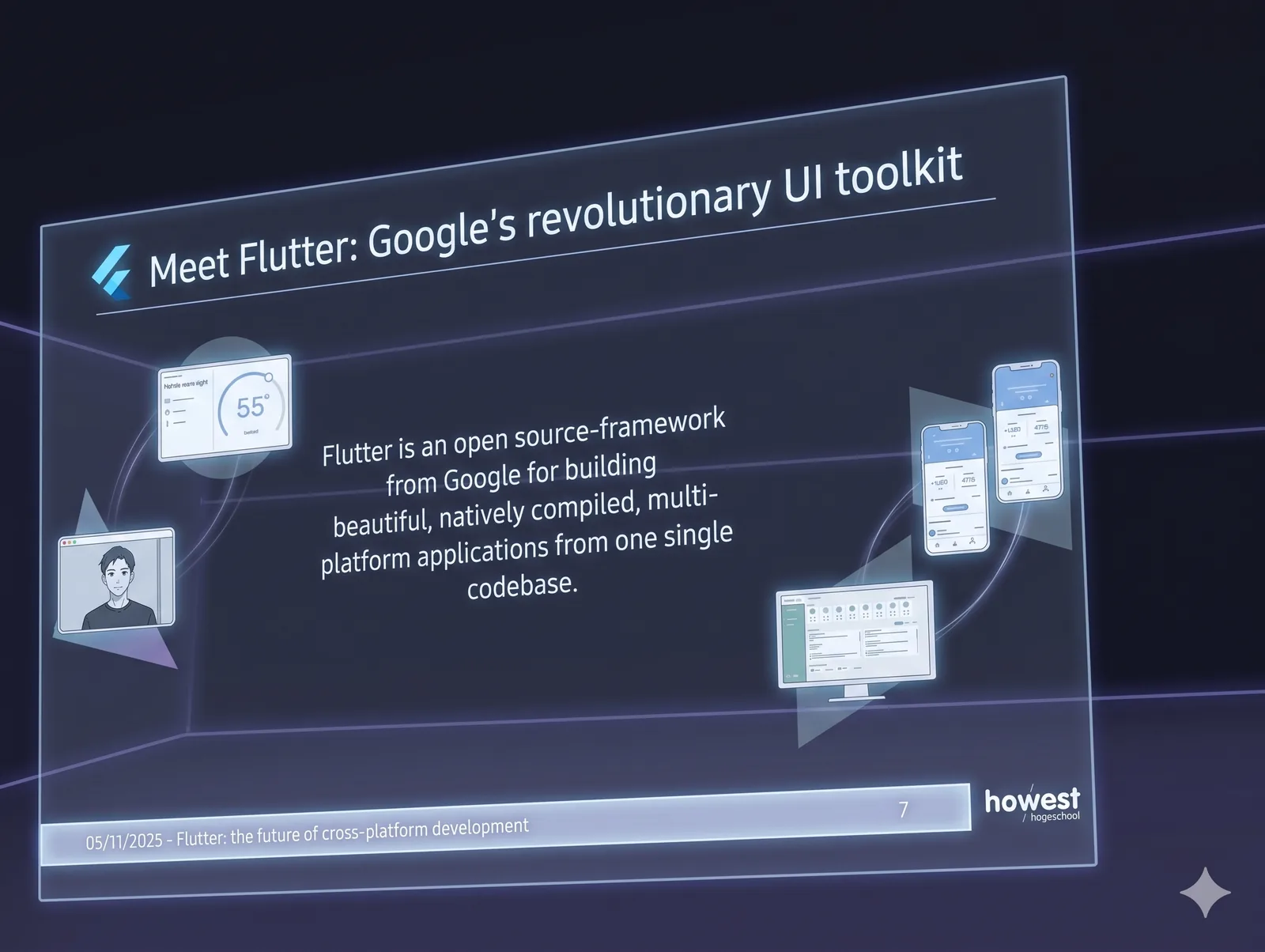
Yesterday, I attended an insightful Tech & Meet session on Flutter, diving into its basics, core principles, and the Dart language behind it. It was a great opportunity to understand how Flutter simplifies cross-platform app development while offering native performance and beautiful UI capabilities.
The basics and core principles
The session walked through Flutter's foundations — what it is, what problem it's trying to solve, and how it differs from the older generation of cross-platform tools. The pitch is straightforward: write your app once, ship it on multiple platforms, without giving up on performance or visual polish. That's a promise plenty of frameworks have made over the years, and Flutter's approach to keeping it is part of what makes the framework interesting to look at more closely.
Dart
We also got a solid introduction to Dart, the language Flutter is built on. Coming from a background that mostly leans Python and Java, Dart was a useful new perspective — close enough to feel familiar, different enough to expose me to ideas about how a modern language can be designed around a specific use case. In Dart's case, that use case is building UIs, and the language is shaped accordingly.
Native performance and beautiful UI
What stuck with me most was the emphasis on UI capabilities and native performance. Flutter takes the look and feel of an app seriously by default. The talk highlighted how the framework is built to make smooth, well-designed interfaces a baseline rather than a goal — with animations, transitions, and platform conventions treated as first-class concerns rather than afterthoughts. Combined with the native performance story, it's a compelling combination for products that care about how they feel to use, not just what they do.
Takeaway
It was a great session to attend as someone who works mostly on backend and ML, but is increasingly interested in how end users actually experience the systems we build. Flutter is now firmly on my radar for future side projects — especially anything where the same product needs to live on multiple platforms without doubling the engineering cost.
Talks like this are exactly the kind of input that opens new directions. The next step is finding a small project to actually try it on.